ADAM MEMBREY

  • ABOUT ME
  • FILM
  • MUSINGS
  • BOOKS
  • DRAWINGS

Give It A Chance: ‘Maggie’s Plan’

January 3, 2017 by Adam Membrey

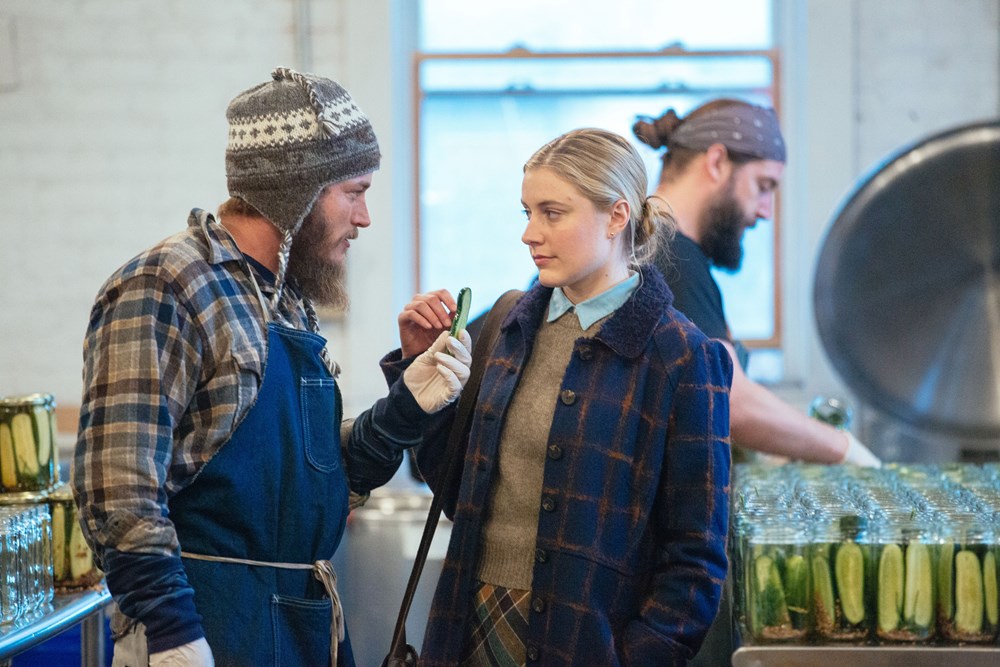
MAGGIE’S PLAN, from left: Travis Fimmel, Greta Gerwig, 2015. ph: Jon Pack/© Sony Pictures Classics


Maggie’s Plan opens quickly with its central conflict: Maggie (Greta Gerwig) is a young college professor looking to have a child, but with no real successful relationship to bolster it. So she has a solution: she’s got an old college friend willing to donate his sperm, and she’ll raise the child as a single mom.

The plan begins falling in place, like dominoes gently bumping into each other, until Maggie meets another professor, John (Ethan Hawke), who’s struggling to write his Next Great American Novel. She reads the first chapter, gives him the feedback he’s been longing for, and off they go. There’s just one problem: he’s married. With kids. She doesn’t realize that she’s not only inspiring him, but also giving him the attention his rising academic star Georgette  (Julianne Moore) can’t seem to afford him.

I’m not going to give away what happens, but I will say there is a point where Maggie realizes the romantic ideals she had may no longer hold weight. What began as a torrid love affair in which she inspired him to write the book he always felt he had in him – so romantic! – has been brushed with the banality and reality of family life a few too many times. At a certain point, Maggie wonders if she’s made a mistake. We don’t often see regret and the genuine inner crisis it births in movies. Often it’s glossed over. And even when Maggie’s Plan threatens to lean into a romantic triangle with way too tidy of an ending, it always, always remains true to the characters. Even the most ridiculous notions have their own internal logic to them, which makes them much easier to swallow. We may not agree with it, but we understand where they’re coming from.

The most jaw-dropping moment to me – the one I’m still thinking about months later – takes place only 20 minutes into the movie. The sperm donor friend Maggie has arranged for – a rather intense, quiet man with a burgeoning pickle business (no joke) – is about to take the donor container into the bathroom and take care of business. Just before he shuts the door, Maggie asks him – a former college math major – why he never became a mathematician.

Guy: I liked math because it was beautiful, that’s all. I never wanted to be a mathematician.

Maggie: Really? You think math is beautiful?

Guy: Anyone who’s touched even a hem of that garment knows it’s beautiful. For me, the hem was enough. Couldn’t have taken the frustration.

Maggie: What do you mean?

Guy: Never seeing the whole thing. You’re always just getting these glimpses of the whole picture. Spending my whole life for scraps of truth.

It sounds like a well-written throwaway mini-monologue, and I’m honestly shocked it’s not something that’s been picked up on or written about elsewhere (the fact the film only grossed $3,070 at the box office probably has something to do with it). But it says everything about the movie. It encapsulates the message in a few short lines from the mouth of a character that nobody – not Maggie, not even the audience – takes seriously.

You can see Maggie struggle throughout the film with never seeing the whole thing. She thinks she knows what a happy family and relationship knows and feels like. She thinks she knows what it takes to get there. But it’s not worked out at all the way she imagined. She’s just getting glimpses of the whole picture; she’s scrapping for truth in real and painful ways. Georgette and John, in their own ways, are also scrapping for these bits of truth. They thought their marriage was terrible, and it, oddly enough, took an affair to realize that maybe they weren’t as far off the mark as they thought.

And so it’s fitting, with her final shots, that director Rebecca Miller reintroduces this odd, rather deep man into the story, right at the last moment when happiness seems to be just around the corner and coming up the hill.

Still available for rent at Redbox and on iTunes. 
Filed Under: FILM

Release Your Smiles: The Vortex’s Atlantis: A Puppet Opera

September 12, 2016 by Adam Membrey

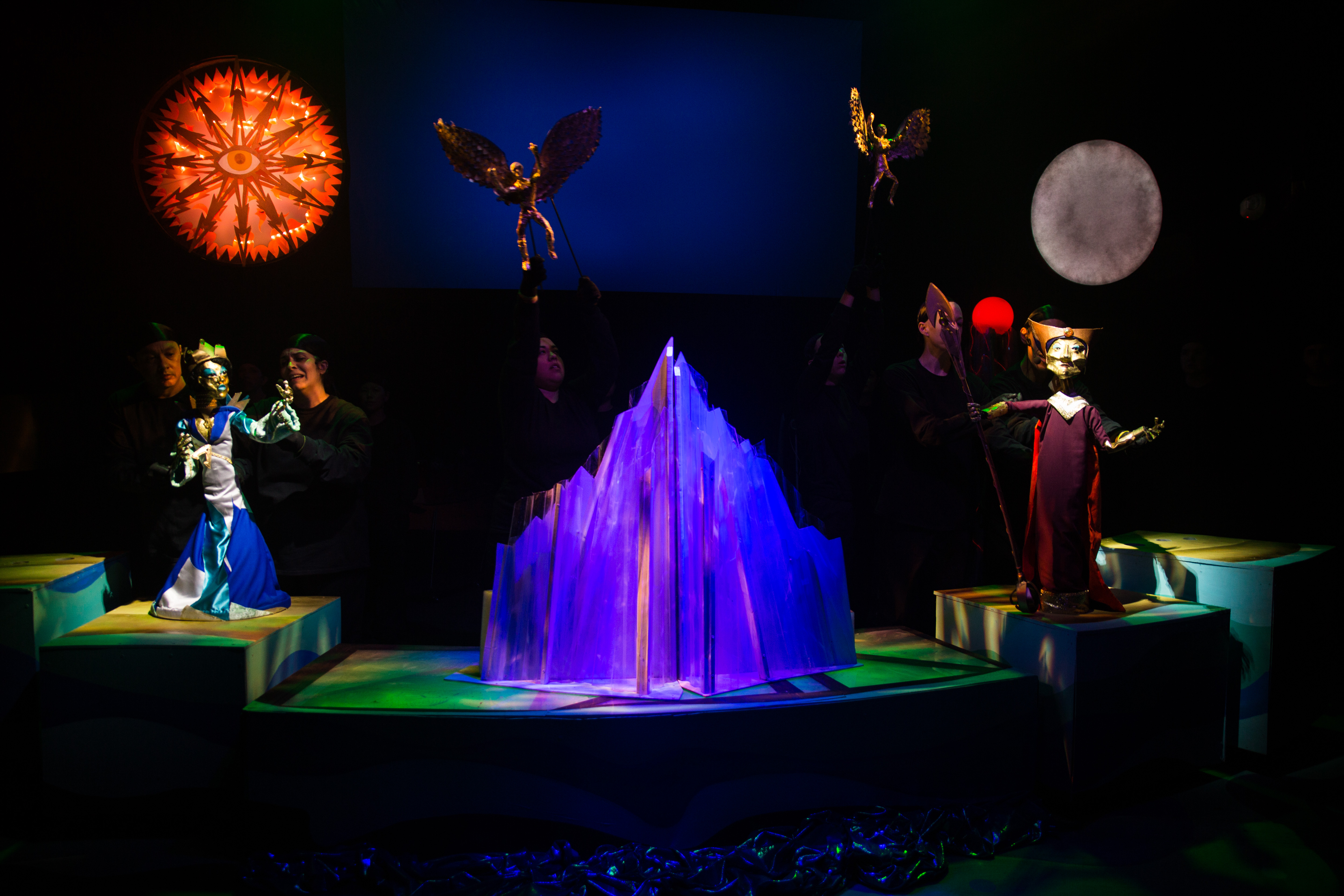
Photo by Andrew J. Friedenthal

In the Spring of 2006, I found myself looking forward to the final (at the time) Pirates of the Caribbean: At World’s End for one specific reason: the kraken. Specifically, the releasing of the kraken.

release

I actually had to Google it. I had no idea what it was. I knew the name sounded like something either fun, dangerous, or a delightful combination of both. My search brought back memories of that rather terrifying beast from the 1954 Disney 20,000 Leagues Under the Sea classic. While the size and pure ferocity of it rattled me as a child, one particular thing gave me nightmares: the beak. I hate beaks. I keep a respectable distance between me and all birds – large, small, wonderful, or fake – because I know what those beaks are for and how easy a tearing opportunity my skin provides it. So, no thanks. The beak can stay.

Thankfully, when I went to see Atlantis: A Puppet Opera at the Vortex last night, a kraken was released, and it did not have a beak. It did, however, seem to be powered by the kind of childhood creativity and glee that we so rarely see these days. I hate creating a false sense of FOMO as much as the next person, but you have not truly lived until you’ve seen a small theater use all their creative brainpower to bring a truly badass kraken to life. Grown adults, with bills to pay and responsibilities to uphold, roll around on the floor in all-black outfits, each holding up and waving a long tentacle towards the puppet characters. It’s just magic.

And then, the highlight: the Atlantis prince, sporting a thick, clenched fist not unlike Hellboy, punches the kraken. The second highlight? When he jumps and kickpunches the kraken a final time. The third highlight? When, for the purpose of perspective in trying to create scale – the main characters look muuuch bigger than the tiny puppets off to the side, even though they’re theoretically the same size in the story – the Atlantis prince gives a fist-bump to a figure much, much smaller than him. It’s so weird and yet so beautiful.

I can tell you all of these things about this play – that the music is fun and skillfully, passionately sung, but that the lyrics may be difficult to understand; that the production design gives every color under the sun a day job; that watching the puppeteers gives you a great sense of the teamwork that goes into making a puppet move – but the best way to sum it up is with a couple I could not take my eyes off of.

They sat in the front row, just off to the side. The wife, on the right, sat there with a permanent WTF face. She either couldn’t believe it, didn’t like it, didn’t understand any of the lyrics, or just simply could not stop her brain from screaming WTF inside her head. But her husband? His face was the vision of unbridled joy. You could not wipe the smile off his face, even with a graffiti cleanup crew. You could see him recognize all of the things that adulthood had told him he should maybe put away. You could see that long-disconnected feeling of creating something with your own hands, regardless of how pretty or lopsided it looks, and doing something because doing it yourself is a stage of cool that we too often forget we can – at any time – pull ourselves up to.

It does not matter if I didn’t pay attention to the story because I was so fascinated by the music and the puppets. It does not matter if the story is surprisingly simple. It does not matter – and I recognize I say this as a Deaf/HH man – if the singing is on point or sounds more like shower singing with a techno beat. Making something worthwhile is not about making it perfect; it’s about making something that helps us separate the signal from the noise. It helps us hear the note too often drowned out. It helps us remember the possibilities we can create for ourselves and our potential audience if we just roll up our sleeves and let our imagination be a part of the process again.

Go see the play while you can, release the kraken and, as you should, release the smile you’re holding back.

Filed Under: MUSINGS

Heil Superman!

April 21, 2016 by Adam Membrey

Recently I drew a picture of Superman for one of my students to color over. I swear I drew that signature Superman curl, but, unfortunately, it was too tight of a curl for a black Crayola marker to navigate. Additionally, I need to work on my philtrum and lip lines because it led to a picture that could easily be mistaken as SuperHitler. Good thing we don’t cover Nazi Germany this year.

HeilSuperman

P.S. My friend Brandt pointed out that there was a Nazi Superman. The name? Overman. In one of DC Comics’ many multiverses, Earth-10 (stay with me here) is controlled by the Nazi Party thanks to Nazi Germany winning WW2 with help from Overman, who was raised by Adolf Hitler. Overman is part of the Nazi version of the Justice League, the JL-Axis. There are two different artistic versions of Overman that have been used: one in which Overman is blonde and has a Nazi swastika on his chest instead of the usual ‘S’ symbol; another is the black-haired twin of Superman, with his S emblem replaced by Schutzstaffel symbol (which looks like an lightning ‘SS’). Definitely not going to explain any of this to my students. The moral of the story: a lot of weird stuff happens in the comics.

Filed Under: DRAWINGS

From Page to Screen: The Light Between Oceans and Me Before You

April 9, 2016 by Adam Membrey

Michael Fassbender stars as Tom Sherbourne and Alicia Vikander as his wife Isabel in DreamWorks Pictures' poignant drama THE LIGHT BETWEEN OCEANS, written and directed by Derek Cianfrance based on the acclaimed novel by M.L. Stedman.

By either serendipity or dumb luck, I found myself reading two upcoming film adaptations back-to-back. Both of them are fantastic in their own way. Both of them have trailers that show they are as perfectly-cast as you could hope for. And both of them will come out in 2016.

I began with M.L. Stedman’s 2012 novel The Light Between Oceans, which follows a young couple, Tom and Isabel, as they are living on a tiny lighthouse island off the coast of Western Australia. One day a small rowboat arrives, with a crying baby and a dead man aboard. Isabel, having just suffered with a series of miscarriages, and seeing that there is no proof of who the dead man is, suggests they keep the child. Tom, uncomfortable with them keeping a child that is clearly not their own, resists at first before accepting it may be for the best. All seems to be well until word carries out that the child’s real mother is still alive and has spent the past few years looking for her daughter.

To say any more would be criminal. This is a story that is beautifully told, but that also creates a situation in which sides will be chosen. I found myself sympathizing with Isabel’s point of view more than my co-worker, who strongly believed Isabel was in the wrong. It provides a great opportunity for discussion, and for a while, I felt the ending would be similarly conflicted. Whatever your opinion of the character’s actions may be, it does give way to one of the most beautiful endings I’ve ever read. It takes what could be a splintering reading experience and makes it something whole again.

Any movie that can boast having Michael Fassbender, Alicia Vikander, and Rachel Weisz is going to be worth anyone’s attention. Even better is that all the roles seem to be perfectly cast. But what I find the secret ingreident to be is writer/director Derek Cianfrance. His 2010 film Blue Valentine led a lot of couples to seriously examine their relationships and his ambitious 2012 film The Place Beyond the Pines seems to be gathering more praise as time goes on. All of this is to say this is not someone who does things in half-measures. You can be sure Cianfrance will dig for all the emotional depth the story provides, direct his actors to fantastic performances, and hopefully leave us with a film worth talking (and, who knows, maybe even arguing) about. It will hit theaters September 2nd, 2016.

MeBeforeYou

While Jojo Moyes’ Me Before You takes place in a completely different time period and location, it is similarly about choices and the consequences of them. Here we meet Louisa Clark, a small-town twenty-something who is suddenly out of a job. Her boyfriend has distractingly become more and more enamored with his own triathlon training. Her family needs some financial support and she has little sense of how to do it. That is, until she hears of a rather particular job offer: working as a personal assistant to Will Traynor, the son of a rather wealthy family that lives nearby.

As simple as the job sounds, the challenge becomes clear: Will is a quadriplegic who, due to a sudden accident, has been robbed of his adventurous, thrill-seeking life. He is now confined to his wheelchair, and with it, his future has been boxed away. The first day on the job leads to Louisa convinced she can’t do it. She can’t change the mind of a men set in his ways of darkened rooms and limited movement. Only through sheer persistence is she able to break some cracks in the armor and let things breathe a little.

Louisa is determined to save Will’s life and make him see all the possibilities ahead of him. Will, on the other hand, has already decided what he wants. It’s nearly halfway through the book before you understand this as a reader, and when you do, it changes everything. Like I said, this is also a book about choices and the consequences that come with them. There is still a rather hilarious, exciting, and heartwarming story to be found within this book. But it also all leads to an ending that I found rather heartbreakingly incredible, but that which may put off others. I give Moyes credit for staying true to her colorful cast of characters all the way to the end instead of using wish-fulfillment fantasies to leaven the truth. It provides an immensely satisfying story that I was not ready to let go of.

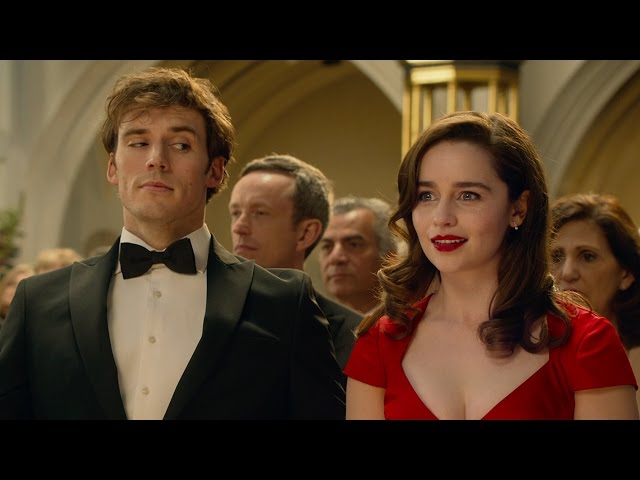
Like The Light Between Oceans, the filmic adaptation of Me Before You appears to be as perfectly cast as one could hope for. I actually heard about the adaptation taking place as I was reading the book, and once I knew Emilia Clarke (Daenerys Targaryen to many) would play Louisa, I couldn’t separate the two. She seems perfectly cast, and the rest of the movie follows suit. I, for one, can’t for wait for June 3rd to arrive.

Filed Under: BOOKS, FILM

Worthy Reads: Noah Hawley’s The Good Father

March 28, 2016 by Adam Membrey

PixaBay

There are two TV shows that I have yet to see a single frame of and yet I am dying to witness: The Americans and Fargo. Both of them are on the FX Network. Both of them have had good to great first seasons that have taken a giant leap to greatness in their second seasons. At the helm of Fargo is showrunner Noah Hawley. The weird thing about names that come out of nowhere is how well they can stick. So imagine my surprise when, on a community trip to the local library with my students, I spotted the name Noah Hawley and immediately grabbed the book. I figured that whatever genius and skill lead him to the reigns of Fargo had to be evidenced in this very book, The Good Father.

The story follows the perspective of Dr. Allen as he is at home with his second family, watching the news coverage of the Democratic primary. The politician at the center of it all is the next Great American Hope, a senator who can bring both sides together and make the future something worth looking forward to. That is, until he is gunned down and later dies at the hospital. The suspect? Dr. Allen’s son, Danny.

I am a sucker for great first chapters, and The Good Father delivers one of the best I have read in a long time. It lays out the details of this horrible crime that took place, narrated by someone we have yet to identify, and then ends with “I am his father, you see. He is my son.” The stakes are laid out. A parent’s worst nightmare is about to be confirmed.

Hawley got the idea for this novel as his wife was pregnant with their first child. He wondered what kind of father he would be and what kind of person his daughter would become. In his interview with the New York Times, asked how fatherhood had influenced his writing, he said, “The other morning I realized with some horror that I had written a novel that requires me to talk at length about the only two subjects in American life that will get you into trouble 100 per cent of the time: parenting and politics.”

In this novel, there are no chapter numbers or titles. There are simple breaks in the text. Each time you see a shortened page indicating a new chapter, you’re given a chance to either take a deep breath or proceed ahead. What is so great about this novel becomes apparent in your breathing patterns. At times you will race to the next chapter; at times you will want to slow everything down.

What I am so struck by with Hawley’s storytelling is how he uses misdirection in a way that reflects how human we are. For the first half of the novel or so, it feels like an intense, clue-to-clue thriller broken up with short chapters about Danny. You are convinced that justice will be served and the father will be given a sense of relief that he, in fact, did not completely screw up his son. But, just as you start to get comfortable with the momentum, it pulls away. The pace elongates, the answers become fewer and less supportive, and the truth increasingly painful.

By the end, Dr. Allen does the one thing his son has asked him to do all along, and it is leaves us with a final line that is as painful as it is cathartic.

Filed Under: BOOKS

  • « Previous Page
  • 1
  • …
  • 17
  • 18
  • 19
  • 20
  • 21
  • …
  • 24
  • Next Page »

Subscribe to Blog via Email

Enter your email address so you can get each post to your inbox. FRESH!

Join 20 other subscribers

Recent Posts

  • Adam’s Top 10 Films of 2024
  • Adam’s Top 10 Films of 2023
  • Adam’s Top 10 Films of 2022
  • Adam’s Top 10 TV of 2022
  • INKTHINK #30: Slither
  • INKTHINK #29: Patch
  • INKTHINK #28: Crispy
  • INKTHINK #27: Spark

Copyright © 2026 · eleven40 Pro Theme on Genesis Framework · WordPress · Log in

  • ABOUT ME
  • FILM
  • MUSINGS
  • BOOKS
  • DRAWINGS